
The Complete Guide to Oxidised Jewellery: Everything You Need to Know
There's something magnetic about a piece that looks like it has lived a hundred lives. Dark, textured, ancient-looking — oxidised jewellery has an old-world quality that no amount of polishing achieves. Whether you noticed it on a Rajasthani artisan's Instagram reel, spotted it layered over silk at a sangeet, or just went looking for something "not too plain but not too loud" — it sticks.
Once you understand what it is, how it's made, and how to actually wear it, you won't approach silver the same way again.
This guide covers the meaning, the making, the metals, the styling, the care — everything. Bookmark it.
What Is Oxidised Jewellery?
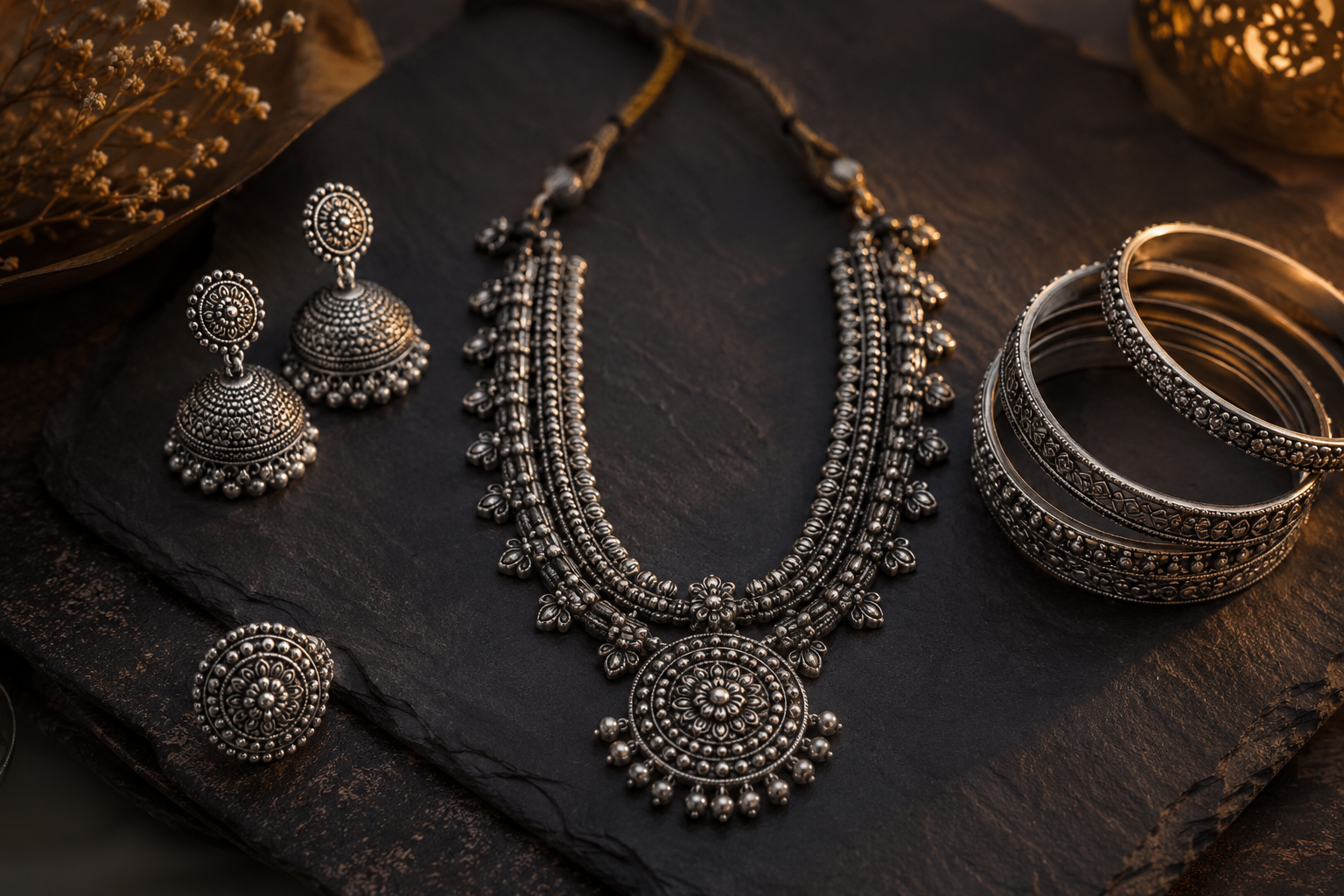
Oxidised jewellery is metal jewellery — silver or silver-toned alloys, most often — that has been treated to appear darkened, aged, and antique. The "oxidised jewellery meaning" people search for is simply this: the intentional ageing of metal, where the surface is made to look like it spent decades tarnishing on its own, even if the piece was made last week.

The darkened effect is called a patina — a thin layer that forms on the metal surface through natural exposure to air and moisture over time, or through an accelerated chemical process in a jeweller's workshop. In nature, silver reacts slowly with sulphur compounds in the air and gradually turns dark. Jewellers replicate this deliberately, but with control over the result.
What makes oxidised jewellery interesting isn't the dark colour by itself — it's what that darkness does to a design. The oxidised finish settles into the recessed grooves and intricate carvings, making every detail pop. Raised surfaces catch light while the deeper areas stay shadowed, giving the piece a three-dimensional quality that flat, polished silver doesn't have.
This is why oxidised jewellery looks best in heavily crafted designs. Jhumkas with fine filigree work, necklaces with layered floral motifs, bangles with temple engravings — the finish turns already complex pieces into something else entirely.
Oxidised jewellery meaning, in short: intentional depth, deliberate age, extraordinary detail.
How Is Oxidised Jewellery Made?
Making oxidised jewellery is a craft of timing as much as chemistry. Natural oxidation happens slowly over years; jewellers replicate the effect in minutes.

The most common method uses liver of sulphur — a potassium polysulphide compound that reacts rapidly with silver to form a black silver sulphide layer on the surface. The jeweller dips or brushes the solution onto the piece, watches the colour shift from golden to brown to black, then stops at the right moment by rinsing in water. Too long and you've gone too dark. Too short and the contrast won't come through. The whole thing is a judgment call.
Once the darkening is done, the piece isn't finished. The jeweller then selectively polishes the raised surfaces and high points, lifting away the dark layer in those spots to reveal bright silver underneath. That contrast — dark in the crevices, bright at the peaks — is the whole point. It's what gives oxidised jewellery its sculpted, antique look.
Other oxidation methods include:
- Chemical baths using ammonium sulphide for a faster, deeper black
- Electrolytic oxidation, more controlled and used in production settings
- Boiling in sulphur water, a traditional technique still used by artisans in Jaipur
The chemistry, for those curious: silver (Ag) meets hydrogen sulphide (H₂S) in the liver of sulphur solution and forms silver sulphide (Ag₂S) — the black compound you see as patina. Because it forms only on the surface, it can be selectively removed from raised areas. Jewellers are, in effect, painting contrast onto a piece using chemistry.
The result looks ancient, feels handcrafted, and changes depending on how the light hits it.
Types of Oxidised Jewellery (Earrings, Bangles, Necklaces, Rings)
The finish works across every jewellery category. A small stud. A dramatic necklace. Stacked rings. Chunky bangles. That versatility is a big part of why oxidised jewellery is so easy to collect.

Oxidised Earrings
The most popular category, and obviously so. Earrings benefit enormously from the oxidised finish because complex details — floral clusters, peacock motifs, temple bells, chandelier drops — show up vividly against the dark metal. Jhumkas, chandbalis, and long tassel earrings are the most recognisable forms. They're lighter than they look, which makes them practical for both everyday wear and occasions.
Shop Oxidised Earrings Collection
Oxidised Bangles and Bracelets
Stacked oxidised bangles pull off something that's hard to explain and easy to see — they look simultaneously effortless and considered. From thin stackable sets to chunky engraved cuffs, they go with kurtas, with denim, with most things. The texture adds interest without demanding the kind of attention loud gold pieces do.
Oxidised Necklaces
Where the category makes its biggest statement. Layered haslis, temple-style chokers, long chains, kundan-studded pieces — all of it. A good oxidised necklace can carry a whole outfit. Pair a heavy one with a plain saree or a simple kurta and you don't need much else going on.
Oxidised Rings
Oxidised rings — stone settings, twisted bands, engraved patterns — attract questions. Stacked on multiple fingers, especially as midi rings, they add texture and attitude. An oxidised ring is not subtle. That's the idea.
What Metal Is Used in Oxidised Jewellery?
Silver is the most common metal in oxidised jewellery. But it's not the only one, and knowing the difference matters when you're buying.

Sterling Silver (92.5% silver): The best choice for oxidised jewellery. Sterling is durable enough for everyday wear, takes oxidation cleanly, and develops a rich, consistent patina. Look for the 925 hallmark on the piece. It holds its finish longer than other metals and is safe for most skin types.
German Silver (White Metal / Alpacca): No actual silver in it, despite the name. It's an alloy of copper, zinc, and nickel, with a silver-like colour. Most affordable oxidised jewellery — the kind found at exhibitions, street markets, and fashion stores — is German silver. It oxidises convincingly and looks good, but it's less durable and can cause reactions in people sensitive to nickel.
Brass: Brass-based oxidised jewellery has a slightly warmer, more golden undertone in the unfinished areas. Common in traditional Rajasthani and South Indian jewellery, brass develops a deep, rich antique finish over time.
Copper: Less common in fashion jewellery. Copper oxidises naturally to a greenish patina. When intentionally oxidised and finished, it can look striking — but it needs more upkeep than silver.
When buying, just ask about the base metal. Sterling silver costs more and lasts considerably longer. For festive pieces you'll wear twice a year, German silver is a reasonable choice.
How to Style Oxidised Jewellery with Indian Outfits
Oxidised jewellery is built on contrast — once you get that, styling it comes naturally.

Bold, deep colours work best. Indigo, mustard, bottle green, burgundy, burnt orange — these make oxidised silver pop in a way that softer shades don't. The dark metal against rich, saturated fabric creates a balance that feels very Indian without being old-fashioned.
With sarees: A solid silk or cotton saree is an ideal backdrop for a statement oxidised necklace or heavy jhumkas. Keep the blouse simple. With a handloom or block-print saree, go lighter on the jewellery — competing patterns don't help each other.
With kurtas and suits: This is where oxidised jewellery is most at home. A long oxidised necklace over an Anarkali, chunky bangles with a straight-cut kurta, jhumkas with a palazzo set — it all works without much planning.
With indo-western and fusion outfits: This is where people are often surprised. An oxidised choker with a crop top and cigarette pants, or oxidised rings stacked with denim — it reads as urban-boho, not ethnic-wear-only. The dark, textured metal bridges Indian and contemporary dressing in a way that gold plating rarely manages.
With pastels: Counterintuitive, but genuinely good. Oxidised jewellery against blush pink, powder blue, or mint creates a contrast that is feminine and slightly edgy at the same time.
One thing to avoid: shiny or metallic fabrics. The matte, textured quality of the oxidised finish disappears against a lustrous surface. Stick to matte fabrics, handlooms, or natural fibres.
How to Care for Oxidised Jewellery
The most important thing to understand: the dark finish is a surface layer. It sits on top of the metal and can be worn away. But it doesn't disappear overnight — with the right habits, pieces hold their character for years.

Cleaning Oxidised Jewellery
How to clean oxidised jewellery comes up constantly, and it's worth getting right because well-meaning cleaning can strip the finish entirely.
✓ Do
- Wipe with a soft, dry cloth after each wear — this removes sweat and oils before they build up
- For lightly dirty pieces, use a mild soap solution on a soft cloth, rubbing gently in the direction of the design
- Dry immediately after any contact with moisture
- For grime in crevices, a soft-bristled toothbrush with gentle pressure works
✗ Don't
- Use silver polish or polishing cloths — they remove tarnish, which means they remove your intentional patina too
- Use toothpaste — abrasive particles scratch and lift the patina layer, despite what popular advice says
- Soak pieces in water or cleaning solutions
- Use ultrasonic cleaners, which strip the surface layer
Storage Tips
- Store each piece separately in a soft velvet or cotton pouch to prevent scratching
- Away from direct sunlight, humidity, and temperature changes
- A small silica gel sachet in your jewellery box absorbs moisture and slows further oxidation
- Away from perfumes, hairspray, and lotion, all of which accelerate uneven tarnishing
When to Take Them Off
Remove oxidised jewellery before showering, swimming, exercising, or doing household work. These degrade the finish faster than anything else. Treat it as jewellery you put on when you're dressed — not something that stays on through the day regardless.
Is Oxidised Jewellery Real Silver?
Depends entirely on where you buy it. Worth knowing the answer before you spend.
Genuine oxidised silver jewellery uses sterling silver — 92.5% pure silver, with roughly 7.5% copper added for strength. If you're buying from a reputable jeweller, this is what you're getting. A 925 hallmark on the piece confirms it.
A large portion of what's sold in India — at local markets, exhibitions, fashion stores — is German silver or white metal alloys, which have no actual silver. These pieces look nearly identical to sterling silver pieces but cost a fraction of the price and don't last as long.
Neither is inherently a bad buy. But you should know which one you have.
Real Silver (925)
- Has a 925 hallmark
- Feels heavier than it looks
- Develops a warmer, more complex patina as it ages
- Lasts years with proper care
German Silver
- No hallmark or vague "silver" stamp
- Lighter in weight
- May cause skin reactions due to nickel content
- Still looks great but needs replacing sooner
The price tells you a lot. If something looks like it should cost ₹800 and is going for ₹150, it isn't sterling silver. That's fine if you know it going in.
Why Oxidised Jewellery Is Having a Moment
Oxidised jewellery isn't new. Artisans in Rajasthan, Jaipur, and parts of South India have used traditional oxidation techniques for centuries. What's shifted is who's wearing it and what they're pairing it with.

Younger shoppers are actively looking for jewellery that has character — pieces that don't look like they came off the same assembly line as a hundred other things. In a market full of identical gold-plated sets, oxidised jewellery reads as deliberate. That's appealing.
There's an affordability factor too, and it doesn't get talked about enough. Silver oxidised jewellery lets you buy dramatic, striking pieces at a fraction of what gold costs. A statement necklace, chandelier earrings, and a set of bangles can cost less than a single modest gold bangle. For anyone building a jewellery collection on a budget, that's genuinely useful.
Deepika Padukone, Vidya Balan, and a steady stream of fashion-conscious women have worn oxidised jewellery in ways that moved it far past "ethnic wear only." It's just jewellery now — versatile, Indian, and not going anywhere.
FAQs
1. What is the meaning of oxidised jewellery?
Oxidised jewellery is metal jewellery — silver or silver-toned alloys, most commonly — that has been chemically treated or aged to develop a dark, antique patina on its surface. The process is called oxidation, and the result is a vintage, handcrafted look that's common in Indian ethnic and fusion jewellery.
2. How do I clean oxidised jewellery at home without damaging the finish?
A soft, dry cloth after each use is the safest option. For deeper cleaning, mild soap solution on a soft cloth works — but avoid silver polish, toothpaste, or anything abrasive. These strip the dark patina. Dry thoroughly after any moisture contact.
3. Does oxidised jewellery turn skin green?
Sterling silver oxidised jewellery generally doesn't. German silver or brass-based pieces may cause some greening or skin reactions due to copper and nickel, particularly in warm weather when sweat increases. Sensitive skin? Go for pieces marked 925 sterling silver.
4. How long does oxidised jewellery last?
Sterling silver with proper care can last many years. The patina may lighten gradually — that's normal and, honestly, part of the character. German silver pieces generally last one to three years of regular use before the finish starts to fade.
5. Can I wear oxidised jewellery every day?
Yes, but a few habits help. Take pieces off before showering, swimming, or exercising. Wipe them down after wearing, and store them in soft pouches away from moisture. Rings and bangles wear faster than earrings or necklaces — they're in more contact with surfaces throughout the day.
Share:
How to Layer Necklaces: Styling Tips Using Thin Chains